

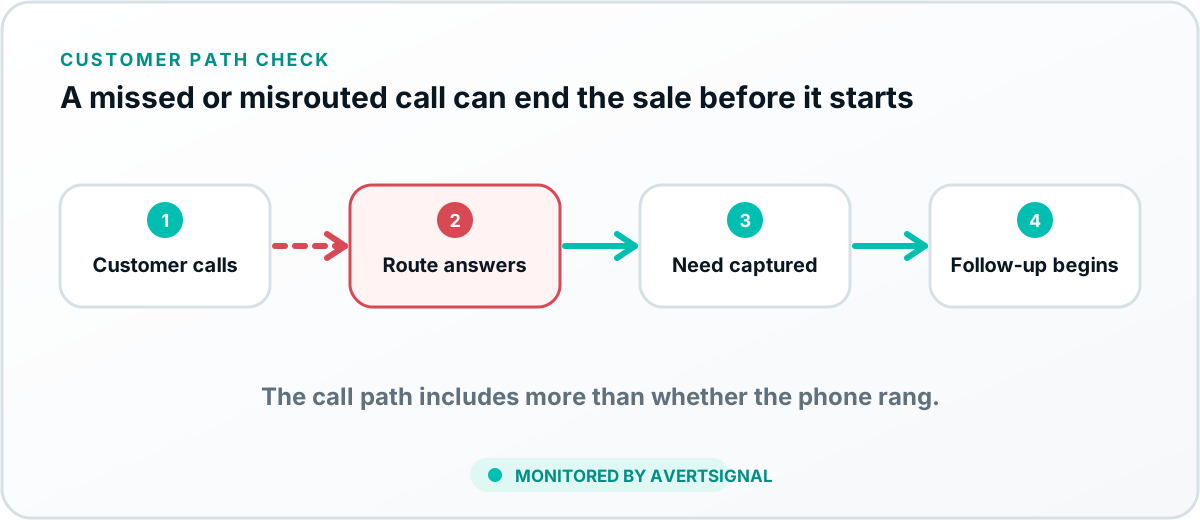
Missed calls cost small businesses by losing high-intent prospects, wasting the marketing that generated the call and sending customers to a competitor. The problem includes unanswered calls, wrong published numbers, broken tracking numbers, incorrect forwarding, poor after-hours handling and missed-call alerts with no owner.
Why phone leads deserve special protection
A person who calls often wants a fast answer: availability, price, an appointment, help with an urgent problem or confirmation that the business can serve them. The caller can move to the next result immediately if the path fails.
That makes the business phone system part of customer acquisition, not merely an office utility.
Four types of call-path failure
Audit every public phone number
Create an inventory of the numbers shown on Google Business Profiles, directories, websites, landing pages, advertisements, email signatures and printed campaigns. Record the expected destination, business hours, provider and responsible owner.
Call each high-value number from an external phone. Do not rely on the phone-system dashboard saying the route is active.
Test click-to-call links on mobile
The visible number and the telephone link can be different. Tap the link and inspect the dialed number. Test location pages and campaign landing pages, especially after call-tracking or website changes.
Check routing, forwarding and menus
- Confirm the correct location or department answers.
- Test office-hours and after-hours rules.
- Review interactive menus and extensions.
- Confirm overflow and failover routes.
- Check tracking-number billing and provider status.
- Test what happens when the primary recipient is unavailable.
Make voicemail useful
A generic mailbox with no response expectation creates little confidence. The message should identify the business, explain what information to leave and set a realistic callback expectation. The resulting alert must reach a named owner.
Measure missed calls without fooling yourself
Track total calls, answered calls, missed calls, abandoned calls, qualified conversations, callbacks and resulting appointments or opportunities. A marketing platform may count a call as a conversion before anyone answers, so compare attribution with the operational outcome.
The article on why conversion tracking is important explains that distinction.
Create a missed-call recovery process
- Send an immediate alert to a defined queue or owner.
- Return the call within the business’s realistic service standard.
- Record the attempt and outcome in the CRM.
- Use an alternate channel when appropriate and permitted.
- Escalate unowned or aging missed calls.
The system should continue working when the usual employee is on vacation, in a meeting or no longer employed.
Protect multi-location routing
Multi-location businesses should verify each public profile, tracking number, geographic route and after-hours destination. A caller sent to the wrong location may be treated as a bad lead when the real problem is system configuration.
Connect call data to the CRM
Where practical, create or update the lead record with the source, number dialed, location, call outcome and owner. That connects marketing activity to pipeline results and exposes calls that were counted but never handled.
How AvertSignal protects the call path
AvertSignal is designed to monitor published numbers, click-to-call actions and expected routes, then connect the failure to customer impact, responsible ownership and verification. It does not need to record or analyze the conversation to prove that the acquisition path reached the right destination.
For the wider system, use the full website and lead-path diagnostic.
The important distinction
A call generated by marketing is not a successful lead if the number, route or response process prevents a real conversation.
Use your own call economics
How much could missed calls be costing?
The honest answer depends on your call volume, the share of callers who are prospective customers, your close rate, and the value of a sale. Start with phone and CRM records where possible. Keep uncertain inputs conservative and label the result Estimated.
Calculate missed-call exposure
The calculator shows its formula and keeps first-sale value separate from optional repeat value. It is a planning estimate, not a claim that every unanswered call would have become revenue.
Trace the handoff after the ring
For one controlled call, verify the published number, route, notification, CRM or call record, assigned callback owner, response attempt, and resulting appointment or opportunity. A provider status can prove that a call reached a route; it cannot prove that the right person followed up.